


Manual, Progressive, Predictive Dialing
We break down which dialing method brings in more conversations and sales.
Spoiler: SalesRender supports all of these dialing modes.
 Manual Dialing
Manual (individual) dialing is a work format where the operator selects an order (or receives them one by one) and independently initiates the call.
Who it’s for
- Companies with 1–2 operators
- Projects with expensive leads where personalization matters
- B2B and complex products
- Low lead volume
Pros
- Maximum control over every call
- Simple workflow without complex setup
Cons
- A lot of time is spent on routine tasks (selecting orders, starting calls, waiting for rings)
- Time loss between orders (the operator finishes one order and doesn’t immediately move to the next)
- Highly dependent on operator discipline
 Progressive Dialing
Progressive dialing is a work format where the CRM system automatically selects the next suitable order and initiates a call. Working principle: “1 available operator — 1 order”.
The operator switches their status to “Online”, after which the system automatically selects an order and places the call. The operator hears ringing and waits for the customer to answer. Upon connection or no answer, the order card automatically opens for further work.
If the operator needs to leave the workplace, they switch their status to “Offline”. In this case, order selection and automatic dialing are paused.
Who it’s for
- Call centers with 3+ operators
- Projects with a warm or hot database
- Lead volume from 30+ per day
Pros
- Automatic selection of the next order without operator involvement
- Minimal pauses between calls and stable operator workload
- High speed of database processing
Cons
- The operator still hears ringing and waits for the customer to answer
- Some time is spent on unanswered calls and voicemail/answering machines (depends on data quality)
 Killer features in progressive dialing
Order skip control. If an operator does not make a sale and tries to discard an order without saving any changes, the system reserves this order for them for 30 minutes. The operator cannot move to the next order until they leave a comment.
Recommended order handling time. A recommended time timer is displayed in front of the operator as a reminder not to prolong conversations or spend too much time on one order.
Provider rotation. If you have multiple communication providers connected, in case of a failed call attempt (connection failure / insufficient balance on provider account), the system will try another provider and will make up to 5 attempts. This significantly increases connection rates.
 Predictive Dialing
Predictive dialing is a work format where the CRM system analyzes operator availability and places multiple outbound calls simultaneously, connecting operators only to “live” customer answers. The system predicts when an operator will become free and adjusts dialing speed to the call center load.
The operator does not deal with ringing: they join the conversation at the moment the customer answers. The system also filters out answering machines and AI bots.
Who it’s for
- Medium and large call centers (10+ operators). The more operators, the better predictive dialing scales
- Projects with large volumes of cold or warm leads
- CPA networks for lead verification
- Teams where maximum operator utilization is critical
Pros
- Maximum utilization of call center resources (all time spent on useful conversations)
- Minimization of time spent on ringing, unanswered calls, voicemail, AI bots
- At least 3× more database coverage, resulting in more sales
- Eliminates early call drops during ringing (when operators hang up before answer)
When applied correctly, there are no business disadvantages. Additionally, this dialing method can be combined with progressive dialing by splitting order databases into hot leads — for progressive — and cooled leads — for predictive.
 How to understand whether you need predictive dialing
One of the simplest ways to decide is to look at your call statistics.
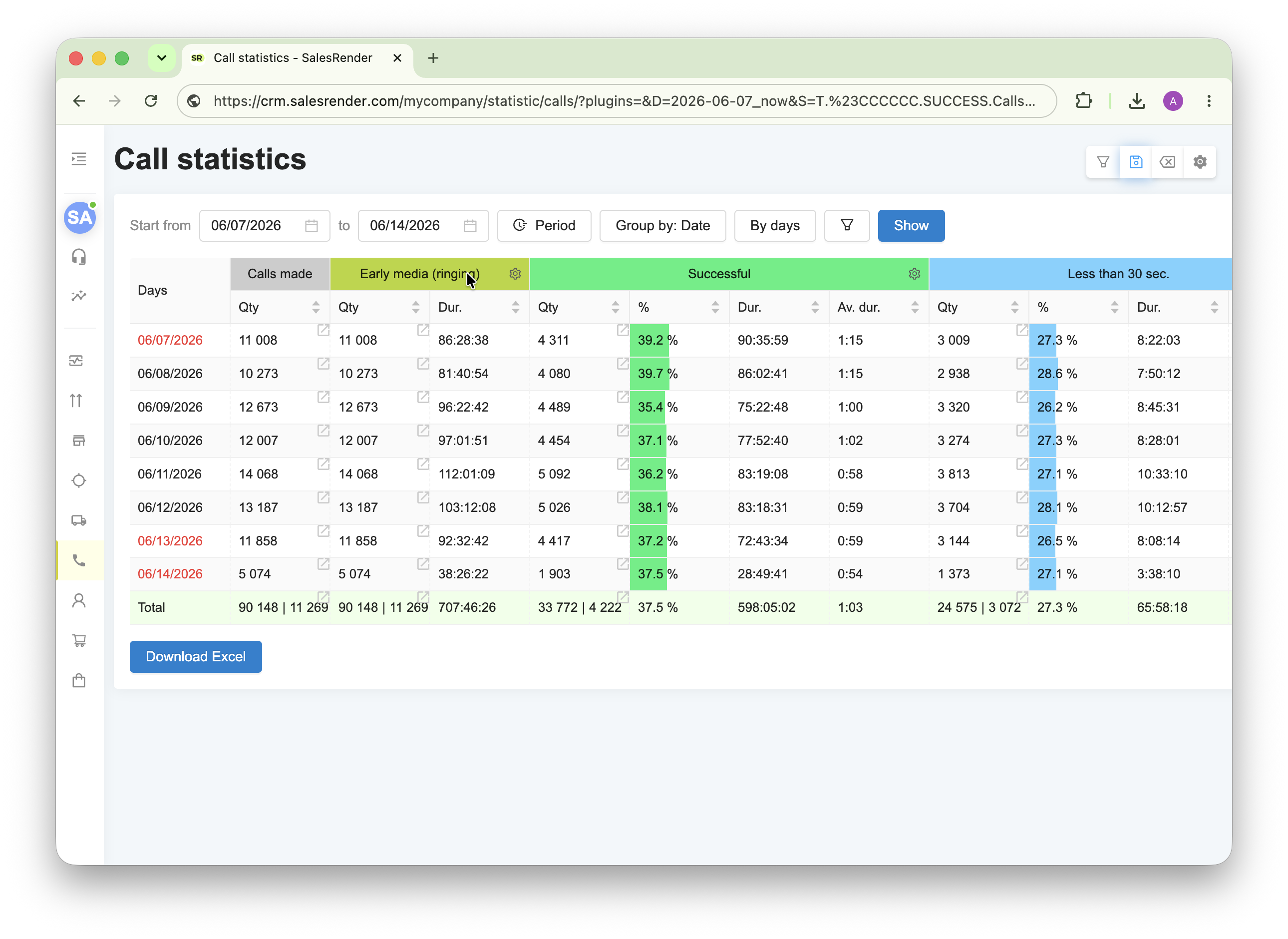
Call statistics show:
- time operators spend on ringing
- time spent on answering machines (calls under 30 seconds)
- average ringing time until successful answer and until no answer
On average in call centers:
- ringing takes 30–40% of total useful conversation time
- when converted into man-hours, this equals 5 operators who are effectively not talking to customers but just listening to ringing
- 17% of calls are dropped at the ringing stage too early, while predictive dialing would have waited for the answer
If you have many answering machines, high ringing time share, potential for large-scale dialing, or weak coverage of current databases — predictive dialing can deliver maximum effect by converting this “empty” time into real conversations.
More about predictive dialing see on the dedicated page
Subscribe to our Telegram channel to stay up to date.
Have questions? Contact our CEO Anna directly.
Thank you for being with us